How to Orchestrate Your Own Business Ecosystem

Freepik
Ecosystems are high-performing business models that revolve around digital platforms. They are built on the collaboration of multiple businesses, each playing different roles across a single or several verticals. The payoff for platform firms can be handsome: A recent analysis showed that players such as ByteDance and Stripe were valued higher than non-platforms, ranging from a 129 percent premium in North America to 39 percent in Asia-Pacific.
No wonder companies aspire to be the orchestrator of the ecosystems they are part of, even though they play different roles (e.g. orchestrator, core partner, technology enabler, complementor or reseller) and are integral to the ecosystem’s value proposition. We explained these different roles in an earlier article.
The challenge, of course, is that it’s not easy to orchestrate a large ecosystem. Firms need to meet three conditions. First, their value proposition should complement customer journeys and, ideally, engage customers via recurring transactions or touchpoints. A company’s positioning should also drive customer loyalty.
Related: Flowers, Bees, and the Secret to Platform Growth
Second, the orchestrator needs to have a critical mass of customers, as the viability of ecosystems depends on network effects. Third, orchestrator firms need deep pockets, since much time and resources are typically required for a large ecosystem to take root.
Given these challenges, most firms start as orchestrators of small ecosystems before scaling up. We examine some of their growth strategies below.
From sidekick to main protagonist
Klarna started in 2005 with a “try before pay” value proposition before venturing into buy-now-pay-later. A customer could get a product first and then pay later. As a payment provider, Klarna was a small orchestrator of customers’ shopping journeys, which were controlled by retailers and marketplaces. However, since 2018, the Swedish fintech company has morphed into an orchestrator of a much larger ecosystem – a trajectory that culminated in the largest IPO of 2025.
The ecosystem canvas timeline below illustrates Klarna's journey from sidekick to protagonist.
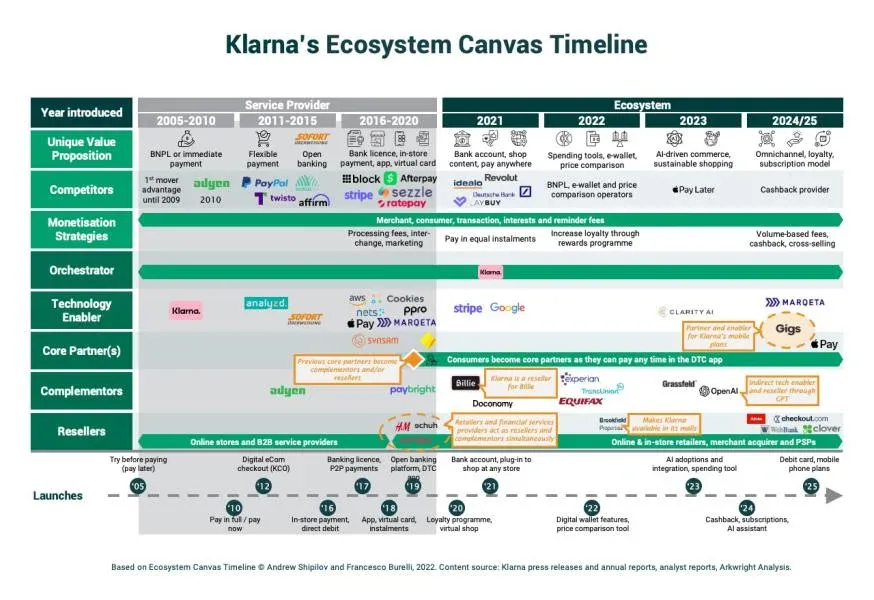
By 2010, Klarna had expanded its range of payment services within five years of its inception. Beginning in 2018, it expanded beyond payments, becoming a retail channel in its own right with an app, then a virtual shop in 2020. It also introduced a loyalty scheme in 2020, price comparison in 2022, and AI integration and spending tools in 2023.
True to its platform ambitions, Klarna’s latest offerings have become highly diverse, ranging from media subscriptions, mobile phone plans and even airport lounge access. Twenty years after its launch, Klarna now has 111 million customers worldwide, works with hundreds of thousands of merchants, and has embedded itself in internet browsers and digital wallets as an alternative to credit cards.
In its evolution from a start-up to orchestrator of a large ecosystem, Klarna relied on these strategies:
- Facilitate the customer journey by becoming a channel enabler. Klarna supported a consumer’s shopping journey by providing in-store deferred payment. When it built its own shopping app in 2018 to scale up its ecosystem, Klarna continued to enable transactions by connecting consumers to retailers such as Macy’s, H&M, Lululemon, Saks and Pandora.
- Focus on customers on both sides of the marketplace and understand what creates value for them. On the seller side, Klarna offers varying payment options to smoothen checkouts and a marketing channel to reach Klarna’s consumer base. On the consumer side, it offers loyalty rewards, cashback, price comparison and an AI assistant, in addition to payment and financing options.
- Develop smart plug-ins across businesses that enable customers to seamlessly shop at any webstore or app. For example, a Klarna customer making a purchase from a web shop that doesn’t offer Klarna payment would be given a one-time virtual card for checking out. The transaction would appear as a normal card payment on the merchant side while the consumer would pay Klarna in instalments.
This helped Klarna lay the foundation for its virtual marketplace, which opened with over 300 initial participating brands such as Levi’s and Hugo Boss, and orchestrate its own ecosystem. In fact, many of the retailers Klarna worked with went beyond participants in its marketplace and became the company’s investors.
More examples
Other companies have used similar strategies to improve their ecosystem positions. For example, Kazakhstan’s Kaspi Bank orchestrated one of the most comprehensive retail ecosystems in Central Asia. Starting with conventional financial services, Kaspi introduced a wallet with merchant and bill payment functionalities in 2014. This and other initiatives established the foundation of a super app driven by customer choice, within which most retailers are complementors.
Similarly, the South African insurer Discovery transitioned from being a complementor offering health and life insurance to orchestrating customers’ healthcare journeys. It did so by creating a lifestyle app, Discovery Vitality, that encourages healthy living and brings its medical and life insurance policies under one umbrella.
With the right strategies, orchestrators of large ecosystems can rise from humble value propositions to engineer flourishing platforms that draws other firms in the ecosystem. Is your company ready to do the same?
Upcoming Masterclass:
Sales with Soul: It's Not Selling, It's Closing with Azril Aswad



Collaborator Description:
This article is published courtesy of INSEAD Knowledge, the portal to the latest business insights and views of The Business School for the World. Copyright INSEAD 2025.
Edited by: Seok Hwai Lee
Business

Francesco is a Partner at Arkwright Consulting AG with a focus on corporate and product strategy and with an industry specialisation in payments and digital banking.

Andrew Shipilov is a Professor of Strategy and the John H. Loudon Chaired Professor of International Management at INSEAD. He is academic director of the Managing Partnerships and Strategic Alliances as well as the Building Digital Partnerships and Ecosystems programmes.