Workplace Mental Health Trends in 2025

Photo by pch.vector @ freepik
Introduction
Mental health is a substantial matter. Yes, there is prejudice and stigma against it, as it has been since time immemorial. On the other hand, there is something brighter. Mental health is being discussed more openly, which is good.
Just over a hundred years ago, workplaces were spaces where mental health went to die. Not only were working conditions dangerous, but they were also physically and mentally taxing. Now, things are changing. Organisations understand that mental health is of utmost importance. They know that not heeding employees' mental health concerns can have wide-ranging effects on employee engagement, employee performance, and, by extension, the organisation itself. Hence, organisations realise that mental health and well-being are indispensable requirements rather than privileges.
Workplaces, as such, are organic. They change and grow; never do they ever remain the same. What may have been just peachy a few others ago might seem something of a relic today. The same goes for mental health. Keeping up with the current trends in mental health is mandatory for workplaces to adapt themselves to the needs of their employees.
Read more: Why Mental Health Conversation Competence is Critical For Leaders' Success
6 Workplace Mental Health Trends
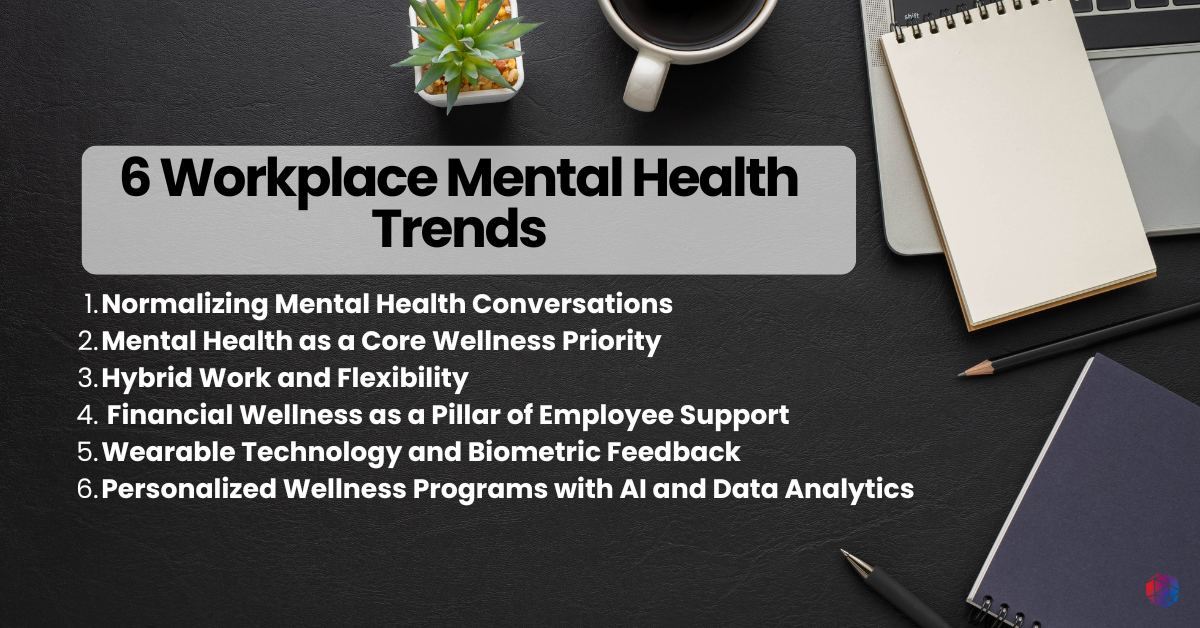
Breaking the Stigma: Normalising Mental Health Conversations
At the top is breaking the stigma and normalising conversations regarding mental health and mental health conditions. The World Health Organisation (WHO) reports that nearly 970 million worldwide are suffering from a mental health condition. That is, nearly 1 in 8 persons struggle with it. Therefore, conversations regarding mental health must be commonplace as well.
So, companies must seek to normalise and even prioritise conversations around mental health. This means cultivating a culture of openness and empathy. It also means leading by example and beginning conversations regarding mental health. Providing access to mental health resources is also quite useful in this regard.
Mental Health as a Core Wellness Priority
Physical safety and wellness are paramount. This is understood. However, mental health and wellness must also become core priorities. Workplaces must seek to prioritise optimal employee mental health, as it can become a core asset to the organisation. This will need reviewing the current policies and making certain changes, like:
- Encouraging openness and understanding regarding mental health.
- Normalising conversations regarding mental health. Specifically, employees who are struggling can reach out and open up.
- Employers perform regular mental health and wellness check-ins with the employees.
- Managers should be aware of the common signs of mental health conditions, like stress, burnout, anxiety, depression, and so on.
- Normalising taking days off for mental health reasons.
Hybrid Work and Flexibility
Hybrid work, remote work, and flexibility are becoming the talking points when it comes to workplaces. These are crucial options for striking a work-life balance. A work-life balance is central to avoiding stress and burnout, among other things. At the same time, work-from-office options and even flexible work options can blur the lines between work and personal life, so much so that it can lead to low morale, reduced productivity, absenteeism, and turnover.
Hence, organisations can enact policies that enforce work-life boundaries, like the "Right to Disconnect" or "Email Blackout Periods." However, organisations can also have an easy leave policy that will encourage employees to use their leave instead of feeling guilty about it.
Financial Wellness as a Pillar of Employee Support
While it might not be nice to hear, typically, employees work to earn. Yet, given the cost-of-living crisis, financial burden is among the top factors that impede employee performance. It causes stress, which is only exacerbated when the employee feels their employer does not care for their financial well-being.
Hence, organisations must understand that prioritising financial wellness can become a pillar of support for employees. This goes well beyond paying wages. It involves offering:
- Financial education
- Debt management resources
- Retirement planning
- Other benefits.
Wearable Technology and Biometric Feedback
We hear all the time that technology is advancing and that the world is becoming more reliant on technology. While many seem rather cynical about this, why not leverage technology for positive things? Wearable technology, like wristwatches (for instance, Fitbit watches), and biometric feedback can be useful devices in telling employees to stand up, take a deep breath, or drink water. Moreover, they can track stress patterns as well.
These small investments on the part of the employers can go a long way in prioritising employees' mental health and well-being.
Personalised Wellness Programs with AI and Data Analytics
If anything has been the talk of the town in the last two years, it is AI or artificial intelligence. One of the primary things in the world that AI is transforming is organisations and workplaces. However, AI has other uses other than enhancing speed and productivity. AI and data analytics can be harnessed to create personalised wellness programs.
AI algorithms can be used to analyse employees' unique histories, such as age, activity levels, dietary patterns, and sleep patterns. This information can then be used to craft customised wellness plans.

Similarly, AI and data analytics can also be used to provide mental health support. For instance, chatbots or virtual assistants powered by AI can offer round-the-clock support for employees dealing with mental health challenges like stress, anxiety, or depression. These tools can offer real-time support by tracking mood patterns, providing coping mechanisms, or suggesting activities like mindfulness exercises.
Final Reflections
Mental health is not an option, rather, it is a necessity. The workplace in 2025 is no longer what it used to be, even five years ago. Things have changed, and organisations realise that a stressed-out workforce leads to lower engagement, productivity, and performance. This is not good for anybody, as productivity losses and turnout related to stress and burnout can cost an estimated $322 billion every year.
Supplementary reading: Recognising the Red Flags of Workplace Mental Health
So, by adopting the mentioned 2025 mental health trends, workplaces can become healthier and happier spaces for employees. Happier employees mean optimal productivity and performance. By taking small steps toward mental health and wellness, employees and organisations can thrive together!
Leaderonomics.com is an advertisement-free website. Your continuous support and trust in us allow us to curate, deliver and upkeep the maintenance of our website. When you support us, you enable millions to continue reading for free on our website. Will you give it today? Click here to support us.


Functional
Tags: Alignment & Clarity, Abundance Mindset, Building Functional Competencies, Mental Health

Dr. Ryan Peterson is a board-certified physician specialising in pain management and addiction medicine. With personal experience in recovery, he is dedicated to helping patients overcome substance use and manage pain with compassionate, personalised care.